Additive Compositionality of Area Embeddings
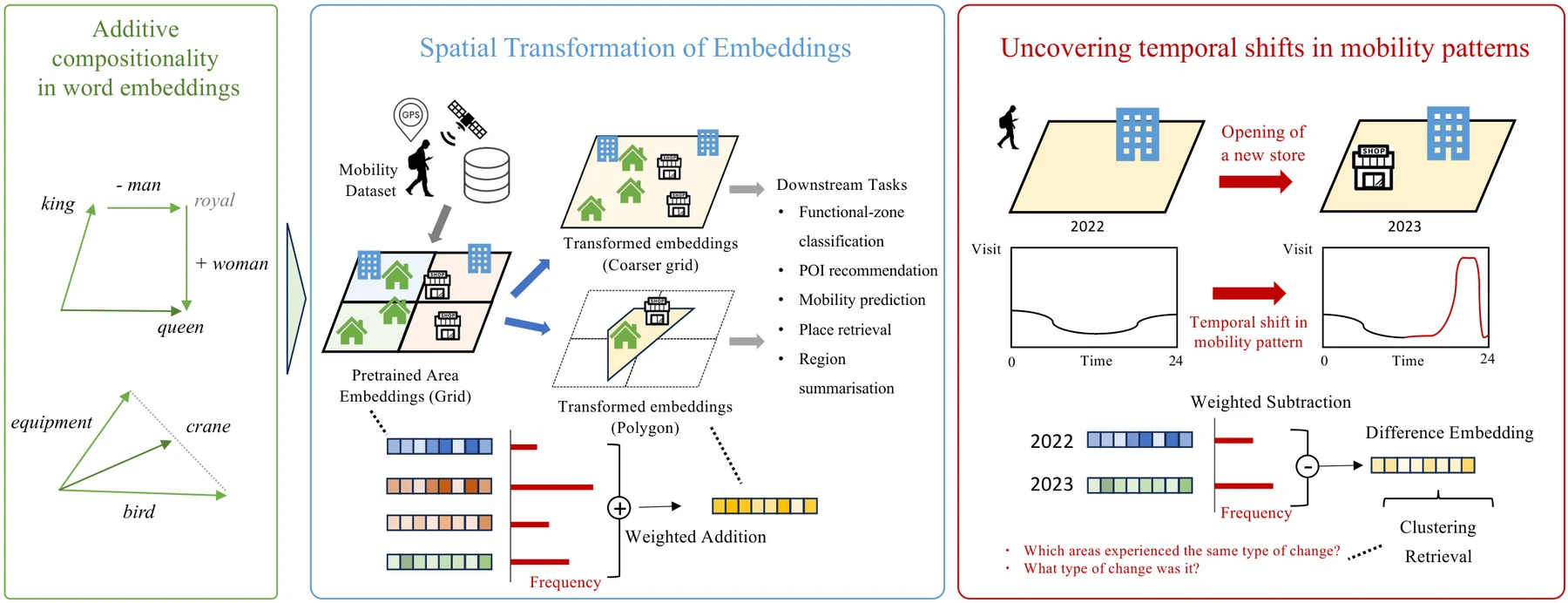
This research studies the property that, in vector representations of areas learned from human mobility data, addition or averaging of multiple areas corresponds to the composition of area-usage patterns or spatial aggregation. It aims to perform spatial-unit conversion and temporal-change analysis on area embeddings (e.g., from Area2Vec) without retraining.
Journal Paper / Conference Paper / IPSJ / Award
Overview
Area embeddings based on human mobility data represent each area in a city as a vector according to how people stay in and move through it. This makes it possible to analyze characteristics such as commercial, residential, office, and tourist areas without relying solely on facility information or administrative boundaries.
However, area embeddings are usually learned for predefined meshes or zones. As a result, when one wants to analyze a region that aggregates multiple meshes, or to convert part of a city into a different spatial unit, the data had to be re-aggregated and the model retrained.
This research introduces the idea of additive compositionality — known from word embeddings — to area embeddings, and analyzes whether averaging the vectors of multiple areas weighted by frequency can approximate the usage pattern of the combined area. For example, composing the vectors of several small meshes can form an area representation at a larger regional scale.
Leveraging this property enables spatial-unit conversion using trained area embeddings, semantic composition of multiple areas, and analysis of mobility change based on differences between embeddings from different periods.
Papers
Journal Article
Naoki Tamura, Nodira Tillayeva, Haru Terashima, Kazuyuki Shoji, Shin Katayama, Kenta Urano, Takuro Yonezawa, and Nobuo Kawaguchi.
Additive Compositionality in Urban Area Embeddings Based on Human Mobility Patterns.
ACM Transactions on Spatial Algorithms and Systems, 12(3), Article 17, 2026.
DOI: 10.1145/3804448
International Conference
Naoki Tamura, Haru Terashima, Kazuyuki Shoji, Shin Katayama, Kenta Urano, Takuro Yonezawa, and Nobuo Kawaguchi.
Additive Compositionality in Urban Area Embeddings Based on Human Mobility Patterns.
Proceedings of the 32nd ACM International Conference on Advances in Geographic Information Systems, pp.577–580, 2024.
DOI: 10.1145/3678717.3691279
Domestic Technical Report
田村 直樹, 庄子 和之, 浦野 健太, 米澤 拓郎, 河口 信夫.
滞在ビッグデータに基づくエリア分散表現の加法構成性の分析と活用.
IPSJ SIG Technical Report (MBL), 2023-MBL-107(55), pp.1–8, 2023. Outstanding Presentation Award
@article{tamura2026additiveCompositionality,
  title={Additive Compositionality in Urban Area Embeddings Based on Human Mobility Patterns},
  author={Tamura, Naoki and Tillayeva, Nodira and Terashima, Haru and Shoji, Kazuyuki and Katayama, Shin and Urano, Kenta and Yonezawa, Takuro and Kawaguchi, Nobuo},
  journal={ACM Transactions on Spatial Algorithms and Systems},
  year={2026},
  doi={10.1145/3804448}
}

@inproceedings{tamura2024additiveCompositionality,
  title={Additive Compositionality in Urban Area Embeddings Based on Human Mobility Patterns},
  author={Tamura, Naoki and Terashima, Haru and Shoji, Kazuyuki and Katayama, Shin and Urano, Kenta and Yonezawa, Takuro and Kawaguchi, Nobuo},
  booktitle={Proceedings of the 32nd ACM International Conference on Advances in Geographic Information Systems},
  pages={577--580},
  year={2024},
  publisher={ACM},
  doi={10.1145/3678717.3691279}
}

@techreport{tamura2023areaAdditivity,
  title={滞在ビッグデータに基づくエリア分散表現の加法構成性の分析と活用},
  author={田村 直樹 and 庄子 和之 and 浦野 健太 and 米澤 拓郎 and 河口 信夫},
  institution={情報処理学会},
  journal={研究報告モバイルコンピューティングと新社会システム(MBL)},
  volume={2023-MBL-107},
  number={55},
  pages={1--8},
  year={2023}
}